Naiw Nakamoto
August 24, 2026
Newsletters

Together with

Greetings Bitcoiner,
Welcome to Issue #632 of the Bitcoin Breakdown daily newsletter, where we’re rounding up the most talked-about developments in the Bitcoin-only space from the past weekend with our Quick Bits and Quick Media sections. But first, today’s Top Stories:
Ray Dalio's debt warning exposes the flaw in measuring a monetary exit with the dollar being escaped. Iceberg distributes Lightning signing authority without breaking compatibility, while Tether's failed Uruguay mining plan shows how quickly state-controlled power access inside Uruguay can strand even well-funded Bitcoin infrastructure.
Live Multisig Workshop

Multisig is strongest when it's multi-vendor. When each key in your vault comes from a different hardware manufacturer, one vendor's flaw can only ever reach the single key it was built into, never enough of your quorum to move funds.
Join the Casa team for a free live session on August 27 at 8am PT where we will walk through setting up a multi-vendor multisig from scratch using your existing devices.

💵 Dalio Prices the Debt Exit in Broken Dollars
Ray Dalio, in a recent LinkedIn post, connects current Treasury market stress to his debt cycle framework and recommends less exposure to bonds, and more gold and Bitcoin. His allocation approach still measures protection in United States dollars, keeping the currency carrying the debt risk as the portfolio's unit of account.
Why it matters: A hedge can reduce debasement damage without changing the scoreboard. Bitcoin becomes an exit when savers measure wealth in scarce money instead of treating it only as a trade for more dollars. Read more→
From a broken denominator to safer Lightning custody…
🔐 Iceberg Splits Lightning Signing Risk Across Machines
Iceberg, a nested threshold MuSig2 design proposed by researchers from TU Wien, Chaincode Labs, Vora, and their collaborators, removes complete Lightning signing control from any single person or internet-connected server while preserving normal interaction with existing nodes and counterparties.
Why it matters: Backward compatibility lets an operator strengthen custody without waiting for network-wide coordination. Distributed signing could help large Lightning operators meet institutional risk, compliance, insurance, and audit requirements. Read more→
From distributed keys to centralized power risk...
🇺🇾 Tether's Mining Plan Hits Uruguay's State Power Wall
Tether's Uruguay Bitcoin mining plans unraveled after a power contract dispute with state utility UTE. Despite mixed public and private generation, the state-dominated grid left UTE controlling how much electricity the planned sites could receive.
Why it matters: Mining capital cannot route around an essential power counterparty overnight. New agreements, dedicated generation, or relocation carry costs, while jurisdictions that make electricity access political should expect mobile hashrate to leave. Read more→


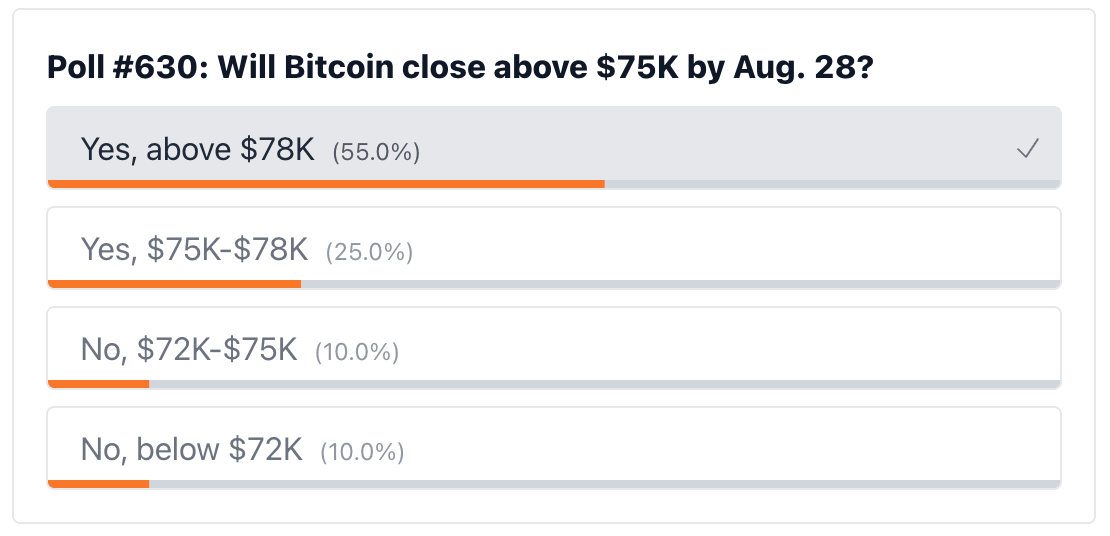

Bitcoin records its largest weekly dollar gain in history, climbing $14,264 to close at $77,387 for the week ending Aug. 23.
Strategy’s Bitcoin treasury returns to unrealized profit as bitcoin surpasses its $75,385 average cost basis.
Matthew Kratter, a Bitcoin educator who posts commentary on YouTube and a prominent proponent of BIP-110, seems to have decided to exit the Bitcoin ecosystem.
Cashu protocol's 𝕏 handle warns that scammers are impersonating the Bitcoin ecash project through unsolicited emails promoting a fake desktop wallet update that installs Windows malware.
Laser Digital, subsidiary of Nomura, Japan's largest investment bank and brokerage group, becomes Japan's first newly approved exchange in four years.
BitMart exchange, considers phased operations and creditor payouts after announcing its shutdown, appointing White & Case and promising a Sept. 9 roadmap.
Families of the 9/11 US terrorist attack victims, seeking damages, challenge US forfeiture of 127,271 BTC tied to Prince Group, alleging the seized funds trace to an Iran-linked mining operation.
Pakistan's Virtual Assets Regulatory Authority opens licensing for the industry, requiring existing providers to apply by Sept. 5 or stop operations under the country's new regulatory framework.
US Treasury doubles long-end bond buybacks to at least $4B per operation to support market liquidity, but yields rebound amid persistent federal debt concerns.
Cleveland Federal Reserve Bank finds that investors’ beliefs in returns drive ownership of Bitcoin and crypto, while exposure to bitcoin’s past gains increases desired allocations and purchases.
US spot Bitcoin ETFs attract $1.92B in their strongest weekly inflow since October 2025, as bitcoin rebounds amid a historic $19B liquidation event.

Cory Klippsten, CEO of Swan Bitcoin, criticizes VC Nic Carter’s weekend article eulogizing ‘Bitcoin Maximalism’ for attacking a strawman that does not represent actual Bitcoiners, while acknowledging that Bitcoiners have not been right about everything (Aug 23 | 6:56 min watch).
Joe Kernen, co-host of Squawk Box on CNBC, says a bearish guest’s statement that bitcoin is worth less than a bucket full of piss when prices recently fell to $58,000 signaled to him that it was a great time to buy (Aug 22 | 0:19 min watch).
Simon Dixon and Doomberg, in an appearance on BTC Sessions' podcast, debate whether BlackRock’s vast assets and Aladdin platform shape global markets or merely follow existing power, while examining financial centralization, geopolitics, and Bitcoin’s future (Aug 23 | 27:14 min watch).
Adam Livingston, in a video for Swan Bitcoin, argues that the $4B Treasury buybacks signal an approaching liquidity cycle in which Fed rate cuts, falling cash yields, and Bitcoin’s fixed supply could drive substantial capital inflows in bitcoin (Aug 22 | 9:52 min watch).
Nik Bhatia of The Bitcoin Layer argues that bitcoin’s recent 22% surge stems primarily from yen intervention and a developing US-Japan monetary alliance, reinforced by bullish technicals, improving liquidity, and rising bitcoin-gold correlation (Aug 22 | 22:33 min watch).
Dante Cook of Simply Bitcoin argues that bitcoin's 22% rally is just beginning as ETF inflows, a historic short squeeze, potential Fed easing, the Clarity Act, global debt, currency devaluation, and de-dollarization strengthen demand for scarce non-government money (Aug 24 | 20:20 min watch).



Thank you for reading!