Naiw Nakamoto
November 24, 2026
Newsletters
Praxis Axes Watchmen 🧮, UK Bars House Trading 🇬🇧, Cross River Takes BTC 🏦

Proof of Press
November 24, 2026 • Reading Time: 4 minutes

Greetings Bitcoiner,
Welcome to Issue #711 of Bitcoin Breakdown, where every Tuesday and Thursday, we bring you the latest must-read Bitcoin thought leadership articles and the newest tools and projects you should know about.
⚡️ Sat stackers, this one's for you: you can now become a Supporter and pay in bitcoin over Lightning. No card, no bank in the middle. Black Friday pricing applies too: $75 a year or $250 for life, locked in while you stay, plus all four Security Playbooks free. Pay in sats here before 1 December.
But first, today's Top Stories: David Tse's Praxis preprint cuts ciphertext size and encryption cost by over ten orders of magnitude, aiming for Bitcoin proof verification without challengers. The UK Financial Conduct Authority bars exchange operators from making markets on their own venues from October 2027. Cross River Bank originates bitcoin-backed loans up to $250K, with pledged BTC held by a qualified custodian.
Lock In 50% Off for as Long as You Stay

Get the Wednesday OPSEC deep dive, the Saturday recap and full Quick Media, plus four Security Playbooks free ($206 value). $75 a year. Ends 1 December.

🧮 Tse's Praxis Aims for Challenger-Free Bitcoin Proofs
David Tse of Byzantine Research and Stanford University, with Nikhil Vanjani and Psi Vesely, posted a preprint on Praxis, a witness encryption scheme. At 100-bit security, the paper reports a 7.88 GiB ciphertext and cuts ciphertext size and encryption cost by over ten orders of magnitude versus prior constructions. The authors give Lean 4 proofs of correctness and extraction.
Why it matters: BitVM-style designs rely on fraud proofs, so someone must stay online to catch cheaters. Praxis aims to let Bitcoin verify off-chain work without trusting challengers or operators. It is a preprint, but fewer watchmen means fewer intermediaries to trust. Read more→
Exchanges, meanwhile, just got a new watchman in London...
🇬🇧 UK Bars Exchanges From Market Making on Own Venues
The UK Financial Conduct Authority's final cryptoasset rules bar a cryptoasset trading platform operator from acting as a market maker on its own qualifying trading platform, effective Oct. 25, 2027. A Treasury order made last week excludes market making on a qualifying cryptoasset trading platform from dealing as principal, so independent market makers can quote there.
Why it matters: Bitcoiners rightly despise exchanges trading against their own customers with privileged order-flow data. Still, exchanges should be free to run their venues as they wish unless they misrepresent their practices, because fraud law punishes liars without a gatekeeper granting permission. Read more→
Across the Atlantic, a bank now lends against bitcoin...
🏦 Cross River Bank Originates Its First Bitcoin Loans
Cross River Bank, a New Jersey state-chartered bank, launched its first bitcoin-backed lending program as loan originator with consumer lender LendingUSA. Borrowers can take $10,000 to $250,000 at 30%, 50% or 70% loan-to-value, with interest-only or no-monthly-payment repayment. A qualified third-party custodian holds the pledged bitcoin, which is subject to liquidation if borrowers cannot add collateral.
Why it matters: A chartered bank originating these loans signals deeper institutional comfort with Bitcoin as collateral. Holders can unlock fiat liquidity without selling their hard money, and more bank competition should mean better terms. Read more→
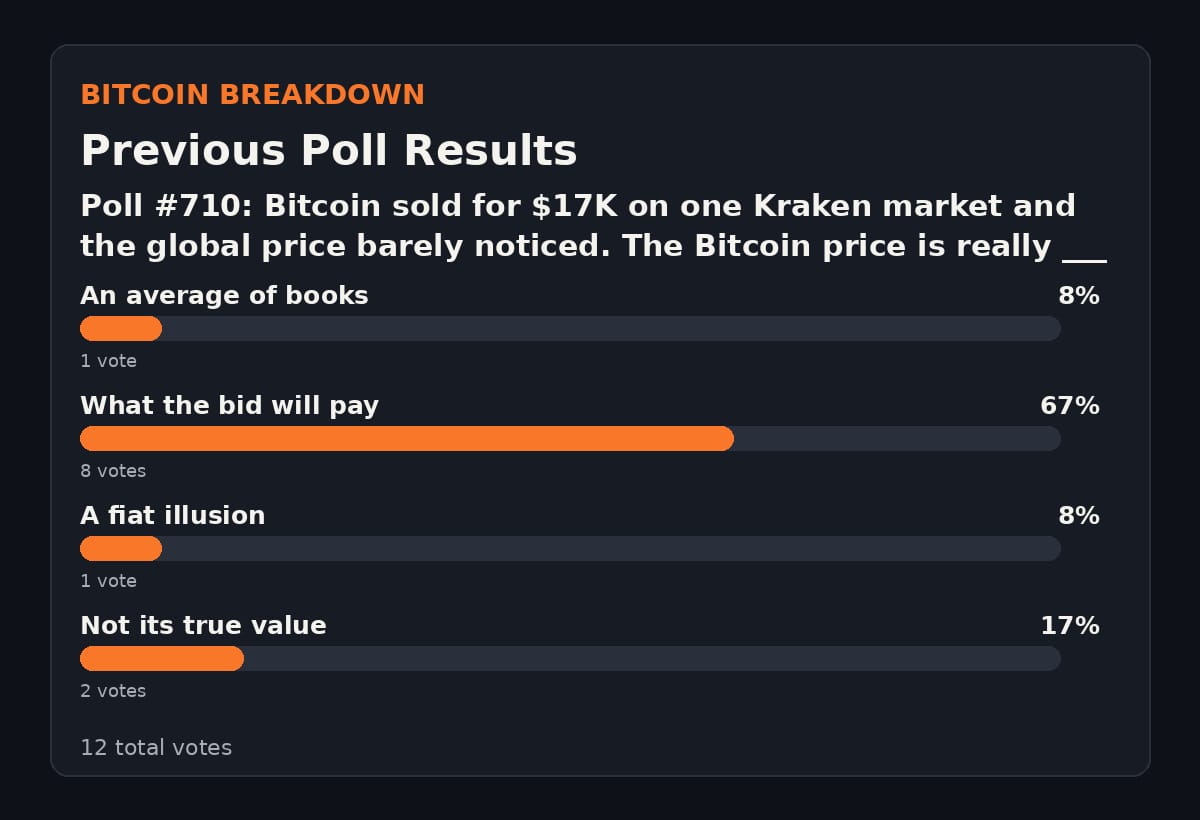
Poll #711: A bank will lend you up to $250K against your bitcoin at 30%, 50% or 70% loan-to-value, held by a third-party custodian. Your move? |
Pick an answer to vote in the issue. Not subscribed yet? You can join free there. |



Adam Gibson aka waxwing, a Bitcoin developer, evaluates the Praxis witness encryption paper, contrasting its 8GB non-interactive ciphertext with Groth16 verification protocol BABE and his own Bitcoin Layer 2 channel framework Lichen while highlighting persistent covenant limitations (Nov 24 | 3 min read).
Daniel Batten, a Bitcoin advocate, debunks nine mainstream media myths about Bitcoin mining, citing peer-reviewed research and empirical data to show how the network stabilizes power grids, lowers consumer electricity costs, and mitigates methane emissions (Nov 22 | 18 min read).
Che Kohler of The Bitcoin Manual explains how AssumeUTXO accelerates Bitcoin node onboarding by using UTXO snapshots for quick usability while verifying history in the background, strengthening decentralization despite temporary trust trade-offs (Nov 21 | 10 min read).
Luka Gubelidze, in an article for the Mises Institute, warns that central bank digital currencies would hand governments the dangerous power to restrict how citizens spend their own money, urging a shift toward decentralized or commodity-based currencies to protect financial freedom (Nov 21 | 7 min read).
Tuma of Bitcoin++ Insider Edition details how P2Pool V2 launched on Bitcoin testnet5 using sharechains, uncle blocks, and a planned futures market to decentralize mining payouts and solve the original protocol's scaling and orphan issues (Nov 21 | 10 min read).
Bitshala, a Bitcoin education initiative growing India's open-source Bitcoin ecosystem, recaps BOSS Summit Winter 2026 in Jaipur, where developers, researchers, and protocol designers explored AI tooling, post-quantum cryptography, Lightning Network security, and self-custody UX (Nov 20 | 14 min read).
Lucas Ferreira and Edil Medeiros of Vinteum share insights from Bitcoin Dialogues and Bitcoin Research Week, emphasizing how researchers, developers, and industry must collaborate on post-quantum security, AI-assisted vulnerability research, and core maintenance to prepare Bitcoin for future challenges (Nov 20 | 11 min read).
Mike Schmidt of Brink warns that 59% of reachable Bitcoin nodes run outdated software exposed to known memory exhaustion, stall, and crash vulnerabilities, urging operators to upgrade to the latest Bitcoin Core releases to protect network stability (Nov 20 | 4 min read).
Btrust Builders, a Bitcoin developer training organization, explains why learning Bitcoin open-source development takes time, drawing on 2026 BOSS Challenge experiences to show how developers bridge theory and working code through practice, collaboration, and sustained effort (Nov 19 | 7 min read).
Bitcoin Policy Institute, a non-partisan Bitcoin think tank now renamed as Finney Foundation for Open Technology, urges UK regulators to align tax, banking, disclosure, and energy rules with existing legal clarity before October 2027 so Britain can capture global Bitcoin market leadership without new primary legislation (Nov 16 | 60 min read).

Liana, an open-source Bitcoin wallet, now uses Taproot by default, hiding timelocked recovery scripts on-chain to improve privacy and reduce transaction fees.
Fedimint, a Bitcoin-based Chaumian ecash protocol, launches a redesigned Observer dashboard featuring federation health, guardian reliability and uptime metrics.
Firefish, a Bitcoin-backed loan platform, launches Private Transfers, giving users dedicated International Bank Account Numbers for instant euro and Czech koruna settlements without sharing banking details.
Zaprite, a Bitcoin and Lightning payment platform, introduces encryption at rest for customer data using per-merchant keys to protect privacy and prevent breaches while allowing order searches.
Bisq, a peer-to-peer Bitcoin exchange, releases mandatory update v2.1.16 to patch a critical Java4Shell vulnerability, integrate Tor security fixes, and ensure uninterrupted trading for users.
River, a Bitcoin financial services firm, announces a new feature allowing users to send bitcoin funded by cash balances rather than their existing bitcoin holdings, avoiding capital gains taxes.
Unravel by Bitcoin developer Nick Farrow is an experimental tool that creates temporary Taproot hop addresses to sign exchange ownership challenges without exposing cold storage.
Lexit by Bitcoin developer Adam Gibson is a testnet layer-two protocol that uses zero-knowledge proofs to guarantee trustless exits from Liquid Bitcoin back to Bitcoin without trusting hubs.
Bitcoin Security Watcher, a monitoring tool, tracks over 100 Bitcoin-only projects and alerts users via RSS, Nostr, and Telegram when vulnerabilities are found, patched, or exploited.
Developer gbotemi is implementing BIP 322 generic message signing and verification in rust-bitcoin to support private key signatures in Bitcoin Development Kit.