Key takeaways
- China's Communist Party calls for a crackdown on corruption involving virtual currency, cross-border funds and blockchain technology.
- The Communist Party decision gives crypto one sentence, does not name bitcoin and says nothing about mining.
- The People's Bank of China (PBOC) led a February notice that extends the mainland ban to offshore yuan stablecoins.

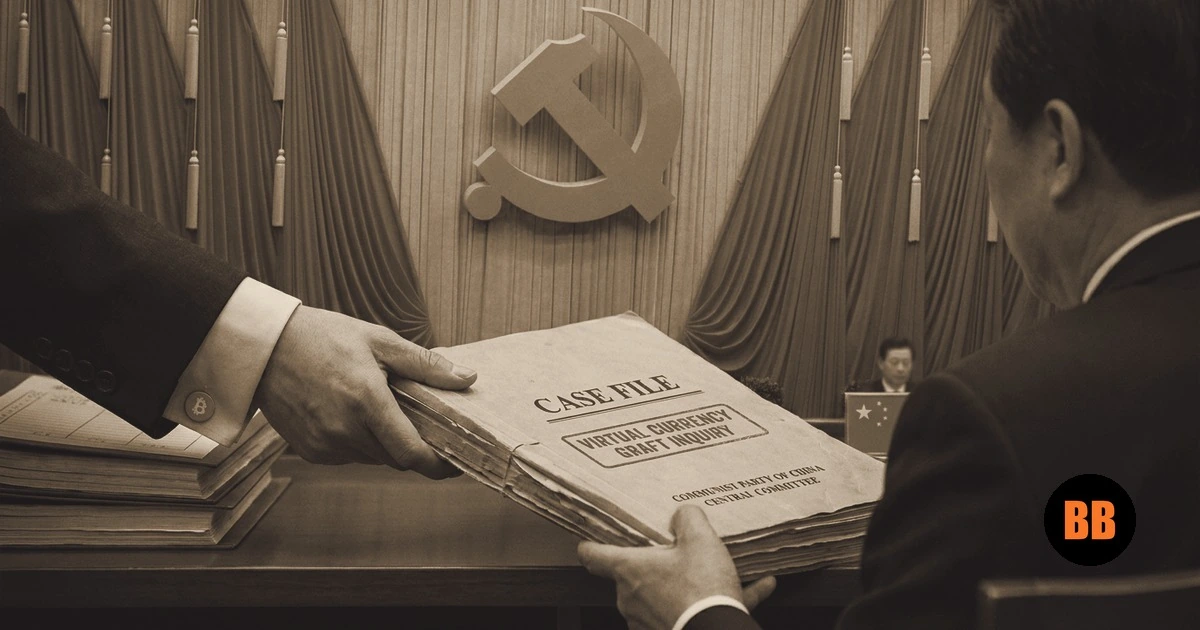
China's Communist Party called for a crackdown on corruption involving the internet, virtual currency, cross-border funds and blockchain technology, in the decision adopted at the Fifth Plenary Session of the 20th Central Committee and published in full by Xinhua. The decision gives crypto one sentence, does not name bitcoin, and says nothing about trading, mining or stablecoins.
The order changes no law, since Bitcoin and crypto trading is already banned on the mainland. The risk falls on officials, their families and fixers.
One Sentence, No Penalties
The decision was formally approved at the conclusion of the fifth plenum, and its full text was released days later. The order sets no deadline, names no cases and carries no penalties.
The same passage of the decision names "white gloves" middlemen and the "revolving door" alongside virtual currency and blockchain. Because the decision does not name bitcoin and says nothing about trading, mining or stablecoins, its target is corruption carried through virtual currency, not a new rule for the market.
A Ban Already in Place
Crypto trading has been banned on the mainland since at least September 2021. A February notice from eight agencies, led by the central bank, the People's Bank of China (PBOC), restated the ban and extended it to offshore yuan-pegged stablecoins and unapproved asset tokenization.
Officials have used virtual currency before. Yao Qian, former head of the PBOC digital currency institute, was investigated in April 2024, and China Central Television (CCTV) reported he took 2,000 ether (ETH) from a businessman in 2018, a stake local media valued at about 68.3M yuan.
With the trading ban already in place, the order changes no law for ordinary users, and the risk falls on officials, their families and fixers.
Why It Matters
In our view, a resolution adopted in China is the party's formal, binding statement of priorities, not a law but an instruction the entire bureaucracy must execute, so every discipline inspector, regulator and court now treats Bitcoin and crypto-linked graft as a live target. The order changes no law because trading is already banned, which means the risk falls on officials, their families and fixers who park hidden wealth in the ecosystem, while the party keeps the permission to decide whose money is legitimate. The same state that bans permissionless money for its citizens is now hunting its own cadres for using it as an exit. Bitcoin held in self-custody is the sovereignty a one-party state cannot grant and cannot fully police.