Key takeaways
- Canada proposes a nationwide ban on Bitcoin and crypto ATMs in its Spring Economic Update.
- FINTRAC reportedly calls Bitcoin ATMs a primary method for fraudsters collecting victim funds nationwide.
- The Canadian ban would also shrink private cash-to-bitcoin access for ordinary people seeking financial privacy.

Ottawa Goes For The Machine
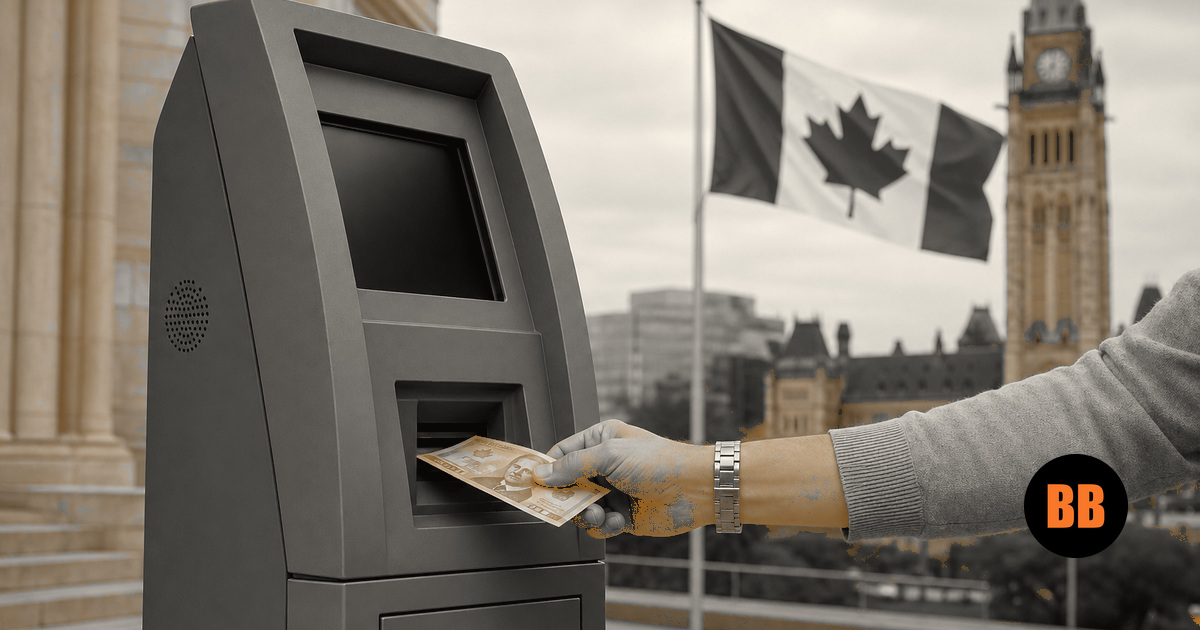
Canada's federal government plans to ban Bitcoin and crypto automated teller machines as part of a broader financial-crime crackdown, according to CBC. The proposal appeared in the Liberal government's Spring Economic Update and follows years of concern from police, regulators, and consumer advocates about fraud victims being pushed toward cash-to-coin kiosks.
CryptoNews, summarizing the proposal, said officials described the machines as a primary method for scammers to defraud victims and for criminals to place cash proceeds of crime. The concern is not imaginary. Scammers have repeatedly instructed victims to withdraw cash, feed it into a kiosk, and send the resulting bitcoin or tokens to a wallet they control.
'primary method for scammers to defraud victims'
FINTRAC, Canada's financial intelligence agency, reportedly found in a 2023 internal analysis that Bitcoin ATMs were likely to remain a primary method fraudsters use to collect and launder funds from victims. Local reports also say Canada has just under 4,000 such machines, the highest number per capita in the world.
Fraud Is Real, But So Is The Ratchet
The scam case is easy to understand. A frightened retiree, a romance-scam victim, or someone caught in an impersonation scheme can be marched through a transaction that feels final before anyone has time to intervene. Bitcoin ATMs can also charge punishing fees and often sit in convenience stores where no trained financial gatekeeper is present.
But an outright ban is not a narrow remedy. It removes a category of cash-to-bitcoin access for everyone, not only scammers. That includes people who do not want every financial action routed through a bank account, an exchange account, or a digital identity stack. The state's surveillance apparatus in any region has a natural hostility toward privacy-preserving movement between physical cash and Bitcoin. ATMs, for all their flaws, make that movement possible.
Canada is not alone. Minnesota banned cryptocurrency automated teller machines in February 2026, and other jurisdictions have considered similar moves. The political pattern is familiar: identify a real abuse case, then solve it by removing the private avenue rather than targeting the abuse with limits, warnings, delays, liability rules, or better enforcement.
Cash Privacy Keeps Shrinking
Money that can move privately is becoming harder to access. Banks monitor deposits and withdrawals. Exchanges demand identity. Payment apps log behavior. Stablecoin issuers can freeze assets. Now the cash-to-bitcoin kiosk is being treated less like a risky venue needing controls and more like a category that should disappear.
That is the part Bitcoiners should watch. Scams deserve serious enforcement, and anyone exploiting vulnerable people should be prosecuted. But financial privacy is not a loophole just because criminals also value it. Ordinary people value it because permissioned finance can punish lawful behavior, expose sensitive activity, and make exit from the banking system dependent on institutional approval.
Why It Matters
A ban on Bitcoin ATMs is sold as consumer protection, but it also fits the broader trend of making private money movement harder. Bitcoin is useful precisely because it gives ordinary people a way to hold and move value outside supervised ledgers. If every cash on-ramp is treated as suspicious by default, the fight is no longer only about scams. It is about whether privacy survives as a normal financial choice.